Quote of the day 24th July 2025

With a slightly different translation, this quote from Galileo kicks off an interesting opinion piece by Christopher Howse in the Telegraph, extracts from which I quote below.
“On Private Passions (the Desert Island Discs for grown-ups), Dava Sobel, the author of that fascinating book Longitude, quoted Galileo: “The Bible teaches us how to go to heaven, not how the heavens go.” ”
“Perhaps Galileo got the idea from the Renaissance man Cardinal Baronius, and I rather think St Augustine of Hippo said something similar in the 4th century in commenting on Genesis. They all took an interest in the way the heavens go, and how the mechanism began. Some solutions were daring.
Medieval thinkers are often blackguarded for blindly following Aristotle, which they didn’t. But on the matter of the age of the universe, Aristotle had a breathtaking thesis: that it had always existed. I can’t quite understand how we have got to the present time if the preceding ages were infinite, but then there are a lot of things that I don’t quite understand.
The eternity of the world was a hot topic in the 13th century. Rediscovered works by Aristotle fed debate, as did his Arabic commentators, notably Averroes (Ibn Rushd, born in Cordoba in 1126). Plato had argued in the Timaeus that the physical universe was created by the Demiurge. Later the Neo-Platonist Proclus (c410-485), in a work now lost, though its argument is recoverable, insisted that the world was eternal, eternally generated by the Demiurge. It was suggested that Proclus was motivated by anti-Christian feeling.”
“By the 1280s, though, we have a Christian, Siger of Brabant (1240-c1284), who keenly argued for the possibility of a world that had always existed. He engaged with Aristotle as interpreted by Averroes and so was caught up in condemnations by the Bishop of Paris in 1270 and 1277 of propositions such as this, said to derive from Aristotle. Paris mattered as the leading university.”
“It is a breath of fresh air to turn to” ... “De Aeternitate Mundi by Thomas Aquinas, who died in 1274. This is clear and well informed. He accepts that the Church teaches that the world was created at the beginning of time, as Genesis seems to say (“In the beginning God created the heaven and the earth...).
But he argues cogently that God could have created a creature that had always existed. God’s own eternity is more than having existed forever: he is not governed by time and his act of creation is not done in a series of motions. Nor does Thomas find any contradiction in a created being having always existed.”
“St Thomas reviews the thinking of Augustine, who argued that the world had been created at the beginning of time. Yet, Thomas insists, Augustine did not assume that it was impossible for created things always to have existed. Their existence is caused by God, be they new, old or extant from eternity.”
“From the lively debates of the 13th century we may conclude that Christians are not obliged to explain the beginning of the universe by the Big Bang. Indeed the Big Bang does not explain why there is anything rather than nothing, any more than this is explained by a steady-state or expanding and contracting universe that has always existed.”
***
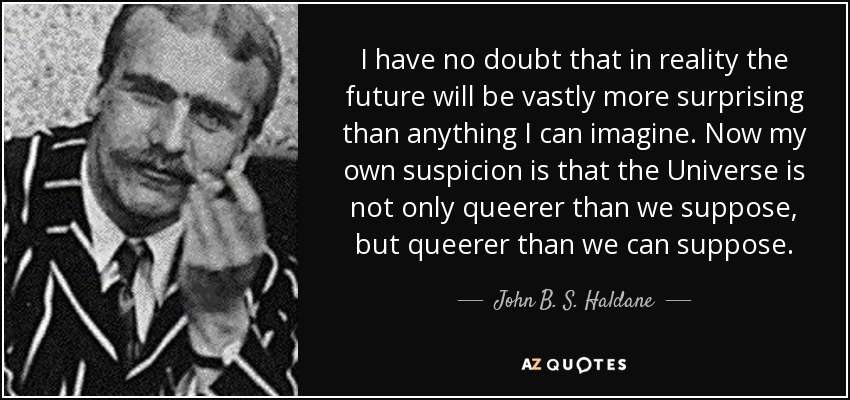
The article above reminds me of the words of Professor Haldane: “The Universe is not only queerer than we suppose, but queerer than we can suppose.”

Comments